
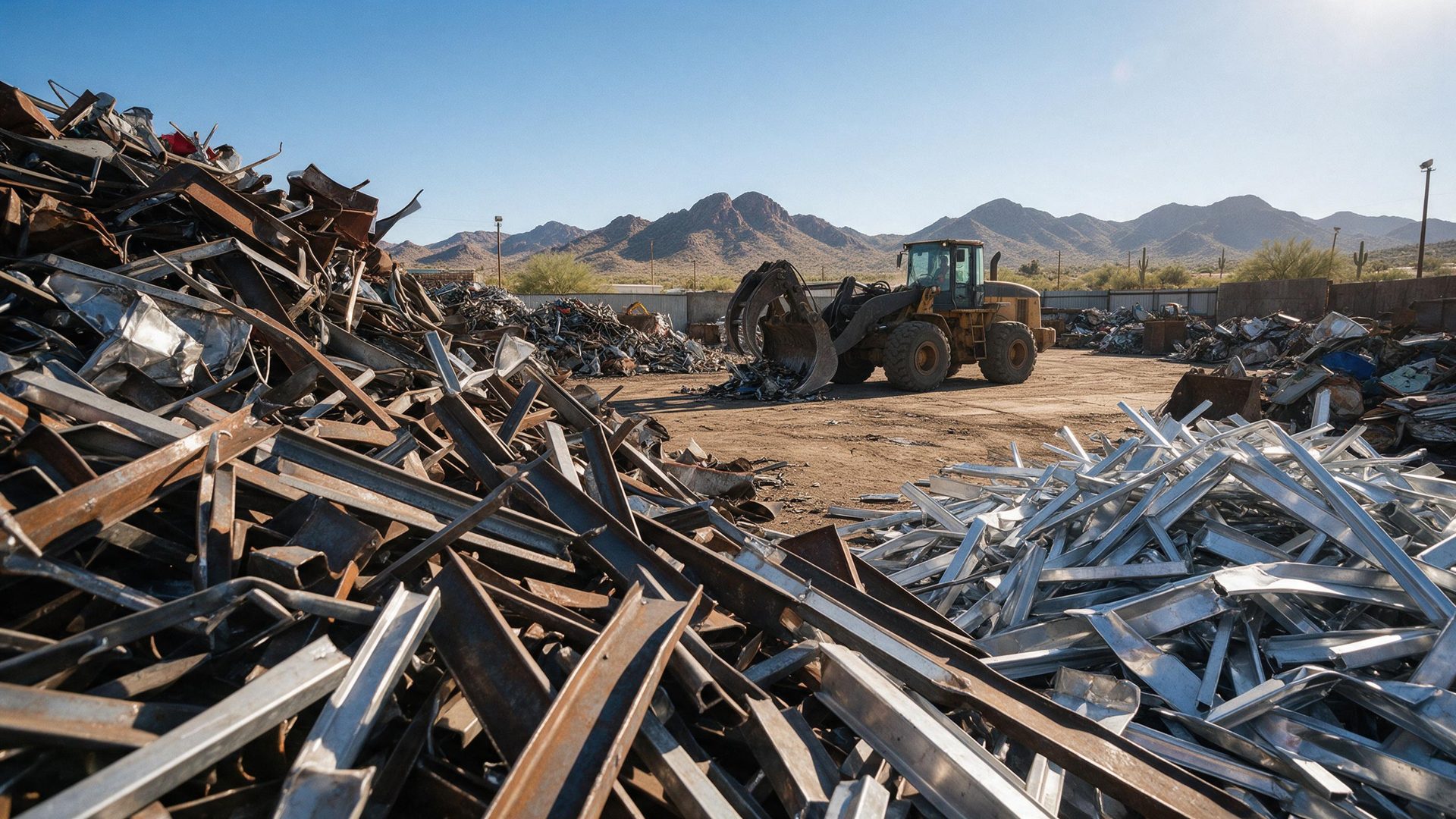
Sell Valley scrap before the sun turns the pile into a hazard
Condenser coils in Mesa, copper from a Scottsdale remodel, racking in Goodyear. Send a photo. A partner yard sets the number.
Live market spot prices, just for reference. Yard prices for scrap are lower and depend on grade.
Live metal spot prices
Local prices vary by yard. Send a photo for a quote. The figures above are live market spot prices from gold-api, for reference only — not a local scale ticket.
Sorting is necessary
Monsoon dust sticks to everything. Hose the worst of it off copper and brass before they sit, or a clean load gets bought as dirty. Keep AC coils separate from steel casings.
What usually pays
How it works
Send us a message
Pickup is arranged across Phoenix and the Valley towns below. Say if the pile is on a roof, in a gated community, or behind a warehouse on the 303.
What Phoenix-area scrap actually is
Air conditioners, pools, and block houses
Phoenix scrap is shaped by cooling. Every failed condenser leaves copper line sets, aluminum fins, and a steel cabinet. Pool remodels add pumps, heaters, and rail. Block and stucco houses from the 1960s through the 1980s — large parts of Mesa, Glendale, and central Phoenix — still give up copper when a bathroom is opened, but the volume is often the AC metal, not a Midwest-style basement full of pipe.
Newer master plans in Gilbert, Queen Creek, and Buckeye produce builder cutoffs instead: short copper, steel studs, and the packaging of a house that closed last month. Those piles are small per lot and constant across a subdivision.
Heat, monsoon, and a season that barely pauses
The Valley does not wait for spring to scrap. Work runs all year, with a slowdown only when the afternoon hits a point where crews will not stand on a roof. That is when dead cars get dealt with too. Interiors crack, batteries fail, and a vehicle that still looked possible in April is clearly done by July.
Monsoon weeks are the other clock. A pile left in a wash or on bare dirt becomes mud and then dust. Copper that sat through a storm looks dirty even when the metal is fine. Photograph it before the weather, and keep it off the ground if you can.
Logistics west, retirees northwest, campuses in Tempe
Goodyear and the warehouses along the west loop turn over racking and dock steel the way a neighborhood turns over water heaters. That is a scheduled industrial load. Northwest, Surprise and the retirement communities produce a quieter pattern: estate cleanouts, a garage full of tools, and gold jewelry that should go to the precious-metals form instead of the scrap trailer.
Tempe adds student-rental appliances on a semester calendar. None of these are the same ticket. Name the city and what the metal actually is.
Questions people ask
Do the spot prices match a Phoenix yard sheet?
No. The live figures are market spot for gold, silver, platinum, palladium, and COMEX copper. Local prices vary by yard. Send a photo for a quote.
Will you take air-conditioner scrap?
A partner yard may. Photograph the coils and the cabinets separately, and do not vent refrigerant. The yard decides what it will accept.
Is there a street address?
No. This is a service-area page. The yard that buys the metal handles the receiving location.
Towns around Phoenix
A Sun City estate, a Buckeye framing site, and a Tempe rental turnover do not belong on the same description. Pick the town.
Sort Phoenix scrap by metal, not by pile
A magnet is a quick first check, not a grade. If it sticks firmly, the piece is probably mostly ferrous, such as steel or iron. If it does not, it may be copper, aluminum, brass, or another non-ferrous metal. Keep the two groups apart when practical. A magnet cannot identify the exact alloy, and some stainless steel is only weakly magnetic or not magnetic at all.
Copper wire is not all priced or accepted the same way. Bare bright usually means clean, uncoated copper wire with no solder, paint, or attachments. #1 and #2 copper allow more contamination or oxidation under yard grading rules. Insulated wire stays in its own category because the insulation adds weight but is not saleable copper. Ask the receiving yard how it classifies a specific load before spending time sorting it.
Brass can be mixed with copper in a cleanup pile, but separating it makes the material easier to identify. Look for solid brass fittings, valves, and parts rather than assuming every yellow-colored piece is brass. Plated steel can look similar. Aluminum also has multiple forms, including cast parts, sheet, and extrusion. Keep heavy cast pieces and cleaner structural shapes separate if the yard requests it.
Clean material generally means metal without attached nonmetal parts, excess dirt, or other metals. Dirty material may include insulation, plastic, rubber, wood, concrete, or sealed components. A yard decides what it can process and how it will grade the load. Do not dismantle a piece just to make it look cleaner until you know whether the extra labor and the risk are worthwhile.
Prepare Phoenix wire, appliances, and equipment before asking
Stripping wire can expose copper, but it takes time and may not improve the result for every load. Thin wire has little copper compared with its insulation, while thick cable can be easier to process. Compare the effort with the category the yard will accept; do not burn insulation, which creates hazardous smoke and can damage the metal. If you are unsure, send a photo of the wire as it is.
Keep air conditioners, refrigerators, freezers, and other sealed cooling equipment intact unless a qualified person has handled the refrigerant. Refrigerant must be properly recovered before the equipment is cut or dismantled. Do not vent it, puncture lines, or separate a compressor from a unit on your own. Ask the partner yard what equipment it accepts and what condition it needs to be in.
Before pickup, gather the material in a reachable place and separate obvious categories where you safely can. Tell the yard about stairs, gates, narrow access, roof locations, loose parts, or heavy items that need special handling. A photo should show the whole load and a closer view of anything unusual. Include the city and a rough description; do not guess at a metal grade.
Protect yourself while sorting. Wear sturdy gloves, eye protection, and closed-toe shoes, and watch for sharp sheet edges, protruding fasteners, unstable stacks, and heavy objects that can roll. Do not climb onto a scrap pile or try to lift a load beyond your ability. Keep children and pets away from the work area, and leave sealed, pressurized, or unknown containers alone.
Phoenix junk cars, catalytic converters, and pickup details
A junk car quote depends on more than its make or appearance. Tell the partner yard whether the vehicle is complete, whether major parts are missing, and whether it can roll or steer. Mention difficult access and anything still inside. A photo of the vehicle and its identification information can help the yard decide what details it needs before arranging a pickup.
Have ownership documents available when discussing a junk-car pickup. Requirements can vary with the vehicle, its ownership status, and the receiving yard’s process, so ask what title or other paperwork it needs before scheduling. If a title is missing or the name on it does not match the seller, explain that upfront. Do not assume a vehicle can be accepted without documents.
Catalytic converters are not ordinary mixed scrap. A yard may ask where one came from and require identification or paperwork before accepting it. Requirements differ by buyer and item, so confirm the process before bringing or shipping a converter. Do not remove one from a vehicle you do not own or have permission to dismantle. Clear documentation can help avoid a wasted trip or a declined transaction.
This site connects sellers with independent partner yards; it does not buy metal or vehicles itself. The yard that accepts a load handles its own inspection, weighing, paperwork, and payment. Before a pickup, ask who will arrive, what must be accessible, and whether the yard needs anything ready besides the material. Keep personal items out of a vehicle and make sure the pickup plan works for the site.
More questions
Does a magnet tell me what a metal is worth?
No. It only helps sort magnetic from nonmagnetic material. It cannot identify an exact alloy, cleanliness, or buyer grade, and some stainless steel may not attract a magnet strongly. Use it as a rough sorting step, then photograph the material and ask the partner yard how it will classify the load.
Should I remove insulation from copper wire before sending a photo?
Not necessarily. Stripping takes labor and can create sharp ends or other hazards, and the yard may accept insulated wire as its own category. Ask how the wire will be graded before stripping it. Never burn insulation to recover copper; the smoke is hazardous and burning can leave the metal contaminated.
Can I take apart an old refrigerator or air conditioner for scrap?
Do not cut refrigerant lines or dismantle sealed cooling equipment unless refrigerant has been properly recovered by a qualified person. Some components also contain oils or electrical parts that need care. Photograph the intact unit and ask the receiving yard what it accepts and whether it can arrange handling.
What should I do with batteries in a junk car?
Tell the partner yard whether the battery is present, missing, damaged, or leaking. Do not put a battery in a mixed scrap pile or try to open it. Keep it upright and away from metal tools if it can be done safely, and ask the yard or an appropriate battery handler how it should be managed.
Can a yard accept a catalytic converter by itself?
Acceptance depends on the yard and the converter. A buyer may ask for identification and paperwork showing lawful ownership or origin. Contact the partner yard before transporting or arranging pickup, and describe the item accurately. Do not remove a converter from a vehicle unless you own it or have clear permission.
Do I need a title to sell a junk car?
Ask the receiving yard before setting a pickup. Title and ownership-document requirements can depend on the vehicle and the seller’s circumstances, and the yard handles its own paperwork process. If the title is missing, there are multiple owners, or the names do not match, explain that early rather than assuming the vehicle can be taken.
What information helps a partner yard plan a pickup?
Share the Valley city, clear photos, a description of the materials, and whether the load is accessible by the pickup vehicle. Note stairs, gates, roof access, tight turns, or heavy items. For a car, say whether it rolls and whether it is complete. The yard can tell you what else it needs.
How should I keep scrap safe before pickup?
Place material on stable ground where it will not block walkways or tip into a vehicle. Keep sharp edges, loose wire, batteries, and heavy items away from children and pets. Do not climb on unstable piles or lift beyond your capacity. Leave sealed containers and unknown pressurized items untouched, and tell the yard about them.
See the products we recommend in the Scrap and Metal Shop at Landforms USA.